The Military’s Offensive Against the Media

The Military’s Offensive Against the Media

The Military’s Offensive Against the Media.

We journalists are under attack. Press freedom is in jeopardy in Myanmar.The last act of aggression happened on Monday when the military arrested The Irrawaddy’s senior reporter Lawi Weng and two Democratic Voice of Burma (DVB) reporters, Aye Nai and Pyae Bone Naing, also known as Pyae Phone Aung.Now the military has charged them as having violated Article 17(1) of the Unlawful Associations Act as they ventured into territory controlled by the Ta’ang National Liberation Army, as part of a reporting trip.The arrest and charges demonstrate that either Myanmar’s military leaders don’t understand the nature and purpose of the media, or that this was a deliberate act intended to frighten journalists away from covering sensitive issues that could lead to criticism of the armed forces.If the military arrested Lawi Weng and two DVB reporters due to what they describe as a connection to ethnic armed rebels, they would have to arrest hundreds of journalists who work for independent media across the country.I am sure that nearly all Myanmar journalists have made contact at least once with members of “unlawful” ethnic armed groups, as all publications across the country have covered the peace process—one of the most important issues facing the nation.Heads of key institutions, including the army and those within the current government, must understand that journalists need to talk to people from all sides of a conflict in order to verify facts, to be able to provide accurate information, and to interpret complex situations and perspectives. If we were to not do this, we would be failing to provide comprehensive information to the public.Since 2011, when ex-President Thein Sein took office and his administration started negotiations with ethnic armed organizations, we journalists also started covering issues concerning conflict more openly. We approached it with a sense of responsibility to help end seven decades of civil war.

Journalists from many publications in the country have traveled to conflict zones, including areas controlled by ethnic armed groups, to speak with rebel leaders, their soldiers, ethnic civil society groups, residents, and refugees.We have repeatedly interviewed and had conversations with leaders and members of such groups whenever the previous and incumbent governments held meetings or conferences relating to peace and conflict in Naypyidaw, Yangon and elsewhere.

Over the past years, ethnic armed group leaders have flown to the capital or to Yangon from their headquarters to attend talks organized by both ex-President U Thein Sein’s administration and the current Daw Aung San Suu Kyi-led administration. The most significant event was the Union Peace Conference, also known as the 21st Century Panglong, held by Daw Aung San Suu Kyi.A number of rebel leaders attended the conference and made speeches alongside the State Counselor and the commander-in-chief of the military.The most recent media arrests by the military are damaging press freedom, a principle that is considered a pillar of the democracy that we are trying to create. In fact, the arrests are limiting greater freedoms that have been realized since the lifting of draconian censorship laws by military-backed ex-President U Thein Sein in 2012.These days, I tend to say to international guests and journalists that Myanmar is not an enemy of the press, as it was under the military regimes of past decades. But the situation seems to be headed backward.While the military appears to be solely responsible for the arrest of Lawi Weng and the DVB reporters, the government holds responsibility, too.We understand that the powerful Myanmar Army did not need approval or a green light from the State Counselor or the President or the National League for Democracy government in order to arrest those journalists. But Daw Aung San Suu Kyi and U Htin Kyaw are the two highest leaders in the country. I believe that they both are responsible for ensuring the protection of citizens’ basic and professional rights, particularly when these rights are abused or mishandled by a powerful institution like the military.

Lawi Weng has been working for The Irrawaddy since 2007. He was a journalist doing his job, as were Aye Nai and Pyae Bone Naing. Since their arrest on Monday, I have sent three letters to the State Counselor, the President and the Minister of Information concerning Lawi’s detention. I have requested that they assist us in finding a way to release him, as he and the other reporters were simply doing their duties as journalists, gathering information in a sensitive area.To be honest, I do not know if either the President or the State Counselor can help out in this matter. But at the very least, I am sure that they can raise the issue with Myanmar’s top military leaders.Daw Aung San Suu Kyi and U Htin Kyaw, the military can be held accountable by your government: they have to answer your questions.The arrest of these journalists is damaging the norms of democracy you’ve promised to achieve under your government. The charges they are facing are an attack on press freedom, which is essential to rebuilding and restoring peace to Myanmar.As state leaders, you are responsible for securing our professional rights to do our job for our country. Please do not let us down.

By Kyaw Zwa Moe – 1 July 2017 – Cartoon / Kyaw Thuyein Lwin

The Military’s Offensive Against the Media

Burma and investigates Rohingya ‘genocide’.


Burma says it will not let outside world investigate Rohingya ‘genocide’ claims

Officials say an ongoing domestic investigation is ‘sufficient’ to look into the allegations.
Burma will refuse entry to members of the UN trying to investigate the alleged killing, violence and abuse against the Rohingya people, an official said.
The government of Aung San Suu Kyi has already said it would refuse to cooperate with a UN mission following a resolution adopted by the Human Rights Council in March.
Kyaw Zeya, permanent secretary at the Ministry of Foreign Affairs, said: « If they are going to send someone with regards to the fact-finding mission, then there’s no reason for us to let them come. »

Mr Zeya added that visas to enter Burma would not be issued to any staff working on the mission.
The Burmese government has repeatedly denied claims that the Rohingya Muslim ethnic group is facing genocide in the country’s remote Rakhine State. It previously brushed away evidence of human rights violations as fake news and « propaganda ».
It also deemed « exaggerated » a UN report published in February which found babies and children were reportedly slaughtered with knives amid « area clearance operations ».
The report concluded counter military operations by security forces were subjecting the Rohingya population to brutal beatings, disappearances, mass gang rape and killings.

Ms Suu Kyi, who came to power last year as apart of a transition from military rule, has been criticised for failing to stand up to the more than one million stateless Rohingy a Muslims.


People in Burma, which is a Buddhist-majority country, have long seen the Rohingyas as illegal immigrants from Bangladesh.

Some 75,000 Rohingyas fled the northwestern state of Rakhine to Bangladesh last year following security operations carried out by the Burmese army.
In March, the EU called for a mission to look into the allegations of abuse in the north of the country.
Indira Jaising, an advocate from the Supreme Court of India, was appointed to lead the mission in May.
But Burma insists that a domestic investigation, which is headed by former lieutenant general and Vice President Myint Swe, is sufficient to look into the allegations in Rakhine.
« Why do they try to use unwarranted pressure when the domestic mechanisms have not been exhausted? » said Kyaw Zeya.
« It will not contribute to our efforts to solve the issues in a holistic manner, » he said.

Last month, Ms Suu Kyi clashed with the EU over the necessity to carry through the UN resolution and send an international fact-finding mission to Burma.
Speaking in Brussels, Ms Suu Kyi said distrust between the two communities went as far back as the 18th century and that what the country needed was time.
« We have not ignored allegations of rape or murder or anything. We have asked that these are placed before a court and trialled, » she said.
She added her government was disassociating itself from the UN resolution « because we don’t think the resolution is in keeping with what is actually happening on the ground. »
During a trip to Sweden earlier this month she said the UN resolution « would have created greater hostility between the different communities. »

The Military’s Offensive Against the Media

Alternative School Near Inle Reimagines Primary Education

Alternative School Near Inle Reimagines Primary Education

Heritage Private School is situated in Chaung Sauk village in Nyaung Shwe Township, Shan State.

Ma Yin Myo Su, the founder of Inle Heritage Private School

The school’s founder Ma Yin Myo Su said she wanted to build a school that was funky, strange and had irregular shapes but was still in harmony with the surrounding area

the school’s buildings, but also its facilities are made out of bamboo.

Kyaw Swar, principal of Inle Heritage Private School

school’s design is a mix of contemporary and traditional architectural forms that fit in to local culture.

Heritage Private School is the first institution of its kind in Nyaung Shwe and Ma Yin Myo Su plans to expand the school to up to 12 buildings, eventually providing high school education.

NYAUNG SHWE, Shan State — On a four-acre plot of land in Chaung Sauk village, surrounded by the Shan hills and near one of Myanmar’s most popular tourism locales, three bamboo buildings resembling spaceships draw nearly every passerby’s attention.

At first glance, these bamboo and earthen structures northeast of Inle Lake could be mistaken for another new hotel or guesthouse. But seesaws and slides in front of the compound reveal that it has been built with children in mind.

It is the very first private school in Nyaung Shwe—an area known in Shan as Yawnghwe—and is open to any child in the local community, with an affordable price tag and run by the non-profit Inle Heritage Foundation.

The founder of Inle Heritage, Ma Yin Myo Su, is also managing director of two resorts: Inle Princess Resort near Inle Lake and Mrauk-U Princess Resort in Rakhine State, and has been recognized for efforts to preserve her ancestral ethnic Intha traditions and conservation of the natural beauty of Inle Lake. The 45-year-old’s most recent contribution concerns an investment in education.

“When I see that there are many babies in the families of my team and in my community, I wanted these children to have a childhood that I wanted myself as a child in this area,” said Ma Yin Myo Su, who guided The Irrawaddy’s reporters around the Inle Heritage Private School.

She stressed the need to have an alternative school in the area—recognized by the Ministry of Education, but with more activities than typical government-run schools—such as art, sports, storytelling, and innovative and creative talks about the environment, heritage, culture, nature and community.

“I live here. I was born here and I make my living here. So I want to give back in any way that I can, especially when the country is changing,” she explained.

In 2012 when Myanmar started allowing private schools, more than 60 schools registered. In the 2016-17 academic year, there were 585 private schools registered with the Ministry of Education, U Kyaw Thu, of the ministry’s department of basic education, told The Irrawaddy.

In a time when the private and international school sector is growing rapidly, fees for Myanmar’s most expensive international schools can run up to US$2,000 per month, per child. Private schools with a government-drafted curriculum start at around 50,000 kyats ($37) per month.

It took Ma Yin Myo Su and her team one year to complete the construction of the Inle Heritage Private School’s first three buildings. The school then launched its first class on June 1. It currently has a total of five classrooms hosting 118 students, from nursery to second grade, and boasts two playgrounds in the compound.

She plans to expand the school to host up to 12 buildings, eventually providing middle and high school education as well. The school’s monthly fees are 35,000 kyats ($25) for nursery and kindergarten and 40,000 kyats (US$30) for first and second grades.


Bamboo As A Building Material

The unique architecture of the school is another reason why it stands out from other standard school facilities in Myanmar, which are typically multi-story concrete buildings with limited play space. Yin Myo Su described it as a mix of contemporary and traditional architectural forms that fits into the local culture and remains close to nature.

To have a school that is made up of funky, strange and irregular shapes yet still stands in harmony with the surrounding area and environment inspired Ma Yin Myo Su’s fundamental vision to use bamboo as a building material for the project.

While Asian cultures have been building with bamboo since the 10th century, the medium has become increasingly popular in modern architecture and interior design as a sustainable and cheaper alternative to timber. Its advantage is that it is fast growing and does not contribute to deforestation, Ma Yin Myo Su explained.

“I want children to start thinking about sustainability, from the building itself, up to anything that they can see and imagine,” she said. “Whoever is going to build either businesses or schools or clinics or houses, it is possible to build in the most sustainable way possible, and there is alternative material that we could use with what we have around us.”

With proper insecticide treatment, bamboo structures can last several decades. It is non-polluting and, according to architects, arguably more earthquake resistant than cement and timber.

Ma Yin Myo Su also highlighted the school’s construction as a chance for her employees to learn how to preserve bamboo and how to treat it so that it is more resistant and durable for longer periods. The project was completed in partnership with Thailand-based architectural and design company Bamboo Family.

 Building Children’s Character

The school of five classrooms currently runs with a total of 17 staff including eleven teachers, two academic consultants and the principal.

Being the first private school in the region, one of the challenges it faces are the expectations from parents who want their children to be outstanding students in terms of grades and distinctions, Ko Aung Kyaw Swar, the school’s principal told The Irrawaddy.

The principal explained that the school’s first ambition is to train children to be morally sound and disciplined persons, while cultivating an attitude of care for the community.

“Education to me is beyond the recognitions of degrees or certificates,” he said. “I personally do not [put] a lot of grand visions or objectives on our kids, but I want them to become responsible for themselves on their own and to at least care for their community.”

The school’s design is a mix of contemporary and traditional architectural forms that fit in to local culture. (Photo: Chanson / The Irrawaddy)

After only the first two weeks of the school’s operation, Ko Aung Kyaw Swar said he was initially afraid that parents would give up on the school and that no children would show up to attend anymore. However, he had received positive feedback from parents that their children had become more independent in their daily lives.

“It’s the very, very first step of a long journey and [parents] need to believe in what we are doing, so we also try to closely collaborate with them,” he added.

Ma Yin Myo Su also said that she dreams of having a small animal farm and vegetable garden in the school compound where students can learn respect for animals, responsible consumption, and environmentally friendly habits.

“We have to give our children the best education, since they are going to lead our country’s next generation one day and decide its future,” she said.

By Tin Htet Paing 23 June 2017 – Photo: Chanson / The Irrawaddy


La souffrance des civils au Nord Myanmar

Nord du Myanmar

Actes de torture et exécutions extrajudiciaires, bombardements aveugles de villages civils, entraves aux déplacements et restrictions à l’aide humanitaire… A l’issue de trois missions effectuées récemment, notre organisation apporte des preuves de crimes guerre contre des minorités ethniques.Les atteintes aux droits fondamentaux ont été commises par des membres de la Tatmadaw (nom donné aux forces armées du Myanmar).

Publié le 14.06.2017.

Des violations commises par l’armée myanmar

Depuis que les combats se sont intensifiés en novembre 2016, l’armée du Myanmar (ex-Birmanie) s’est rendue coupable de graves violations contre les civils, qui s’apparentent parfois à des crimes de guerre.
Nous avons documenté neuf cas dans notre dernier rapport où des militaires ont arrêté arbitrairement et torturé des membres de minorités ethniques dans le nord de l’État chan.
Par exemple, en novembre 2016, 18 jeunes hommes ont été massacrés dans le village de Nam Hkye Ho. Selon deux témoins, une centaine de membres de l’armée du Myanmar sont entrés dans le village après avoir combattu la MNDAA non loin de là. La plupart des villageois, dont les femmes et les enfants, avaient fui à l’approche des combats. Les soldats ont laissé partir les hommes âgés avant d’emmener les jeunes hommes sous la menace d’une arme. Peu de temps après, les villageois qui avaient pris la fuite ont entendu des coups de feu en provenance de la direction qu’avaient prise les soldats.
Ils ont franchi la frontière pour rejoindre la Chine. Quand ils sont revenus dans leur village plusieurs semaines après les faits, ils ont trouvé deux charniers où avaient été jetés des restes de corps.
Nous avons vu des restes calcinés de ce qui semblait être un corps. [Il y avait] des os, mais c’étaient surtout des cendres. Nous avons retrouvé certaines de [leurs affaires]… Nous savions déjà que les 18 personnes avaient disparu. Un ancien du village.

….. / ….

Les Exactions par les groupes armés

Près de 100 000 personnes ont dû quitter leur maison en raison du conflit dans le nord du Myanmar.
Même si de nombreux membres des minorités ethniques considèrent les groupes armés comme leurs protecteurs, ils sont aussi victimes d’exactions de la part de ces groupes.
Différents groupes armés enlèvent des civils considérés comme proches d’une partie adverse, pratiquent l’enrôlement forcé, notamment d’enfants, et imposent des « taxes » à des villageois pauvres, pris au piège dans la zone de conflit.
Près de 100 000 personnes ont dû quitter leur maison et leur ferme en raison du conflit et des violations des droits humains dans le nord du Myanmar.


Lire aussi : des centaines de personnes Rohingyas disparues au Myanmar

Le terrible déplacement de population

Ces déplacés sont actuellement dans le nord du pays, alors que les affrontements entre les forces armées du Myanmar et différents groupes ethniques armés, dont l’Armée pour l’indépendance kachin (KIA), l’Armée de libération nationale ta’ang (TNLA), l’Armée d’Arakan (AA) et l’Armée de l’alliance démocratique nationale du Myanmar (MNDAA), continuent de faire rage dans la région.

Le gouvernement du Myanmar a exacerbé encore les difficultés pour de nombreuses personnes déplacées en restreignant l’accès des organismes humanitaires à certaines zones en proie au conflit, en particulier celles contrôlées par des groupes armés. Des représentants de ces organismes ont déclaré que ces restrictions limitaient leur capacité à réagir rapidement à des situations d’urgence et à fournir l’aide humanitaire nécessaire, en matière notamment d’abri, d’accès à l’eau et à des installations sanitaires.

Des mines terrestres aux engins explosifs improvisés

Les forces armées du Myanmar comme les groupes ethniques armés se servent de charges explosives, posant des mines terrestres antipersonnel ou des engins explosifs improvisés (IED) qui, bien souvent, blessent des civils, dont des enfants, alors qu’ils vont travailler ou rentrent chez eux après avoir été déplacés. L’armée du Myanmar fait partie des quelques rares forces armées nationales au monde (avec la Corée du Nord et la Syrie) qui utilisent encore des mines terrestres antipersonnel.
Toutes les parties au conflit doivent cesser de se livrer systématiquement à des violations des droits humains contre la population civile, et les autorités du Myanmar doivent mettre fin au cycle de l’impunité en enquêtant sur ces violations et en engageant des poursuites contre leurs auteurs.
Aung San Suu Kyi accorde la priorité au processus national de paix mais, pour qu’il aboutisse, il devra reposer sur l’obligation de rendre des comptes et sur le respect des droits de l’ensemble de la population civile, y compris de ceux des minorités ethniques.

Publié le 14.06.2017.

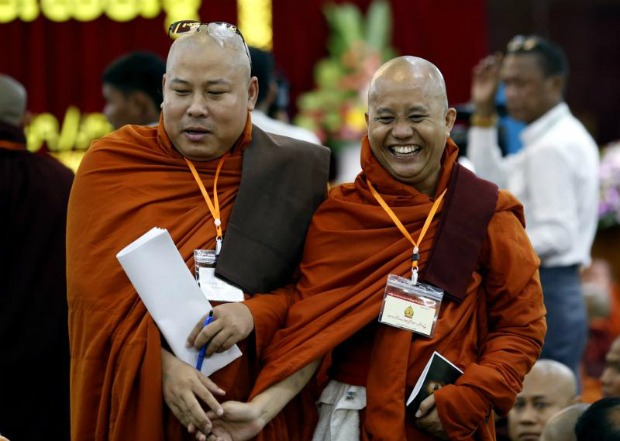
We Love Wirathu : Campaigns Launched

Supporters of firebrand nationalist monk U Wirathu launched campaigns to garner signatures in his support in Karen State and Mandalay Region earlier this month.
The “We Love Wirathu” campaigns were launched in response to allegations that U Wirathu’s sermons were against Buddha’s teachings, according to campaign organizers.
“I believe U Wirathu is on the side of Dhamma [the doctrine or teaching of the Buddha], and I’m upset that some people call him on the side of Adhamma [against the Buddha’s teachings],” said a supporter of the petition in Karen State, who declined to give their name. “So, we confirm with our signatures that he is on the side of Dhamma.”
The campaigns came as the Anti-False Buddhist Doctrine Group collected signatures across Yangon for a petition asking the State Sangha Maha Nayaka Committee, better known by its Burmese acronym Ma Ha Na, if the actions and speeches of U Wirathu conformed with Buddha’s teachings or not.
One campaign, held at a monastery in Karen State’s Hpa-an Township on June 11, garnered around 10,000 signatures and another on June 14 in Myawaddy Township got more than 300 signatures, campaign organizer and Hpa-an local Ko Thurein told The Irrawaddy.
“There is an ongoing campaign in Yangon, saying that Sayadaw U Wirathu’s sermons contain Adhamma things,” said Ko Thurein. “We organized these campaigns to show that he is not Adhamma, and that there are many people who love him.”


People from other townships in Karen State and in Mon State’s Mawlamyine (Moulmein) Township have contacted him to organize similar campaigns in their respective places, he said. The signatures collected will be presented to U Wirathu, he added.
Last week, the Patriotic Monks Union (Mandalay) and U Wirathu’s supporters conducted a campaign and garnered over 55,000 signatures, said U Wirathu’s supporter Mandalay local U Naing Win Tun.

“Those who speak ill of the Sayadaw [U Wirathu] online do so because they don’t know exactly what Sayadaw is doing,” he said.
The Anti-False Buddhist Doctrine Group conducted a petition against U Wirathu in nine townships in Yangon Region from May 21 to June 17. The founder of the group Ko Myat Kyaw said the number of signatures would be announced on Wednesday.
“We don’t want him to be jailed or ruined, we just want to show that we do not accept his false doctrine,” Ko Myat Kyaw told the press in May.
The petition will be put forward to the Ministry of Religious Affairs and Culture on Wednesday, and will also be sent to the President’s Office, the State Counselor’s Office and the Ma Ha Na.

Regarding the “We Love Wirathu” campaigns, Ko Myat Kyaw said: “I agree to disagree. They have the right to [campaign], and I cannot do anything.”
The campaign organizers of “We Love Wirathu Campaign” said similar campaigns would continue across the country, and an online voting system was also launched on June 17. A total of 13,209 signatures were collected by Tuesday, according to organizers.
U Wirathu was banned by the Ma Ha Na from delivering sermons across the country for one year, starting from March 10, due to his religious hate speech.

YANGON — By Zue Zue 21 June 2017


The Military’s Offensive Against the Media

A Frontline Dispatch From the Tanai Conflict

Under the heavy rain, I boarded a boat with a group of fellow reporters and made my way to a patch of Kachin Independence Army (KIA) territory threatened by the Myanmar Army about an hour from Tanai town.
Thousands of locals and migrants working the area’s gold and amber mines have fled the surrounding villages of Tanai in Kachin State since fighting broke out between the KIA and the Myanmar Army, also known as the Tatmadaw, on June 6. Many of the internally displaced people (IDPs) have sought shelter in Tanai town.
But as we stepped off the boat, four KIA mining officers awaited us, looking pleased to have the company. They had not yet received orders to leave, although the other mining workers had left, and so these were our guardians for the trip.
One of the men, Myit Aung, an acting officer appointed in January, told us to sit in a small shop for a while before going to the mines, which are based on land controlled by Battalion No. 14 under KIA Brigade No. 2. On June 15, shop owners were packing up and closing their businesses. They would leave from the same modest dock where we had arrived, but a few shops remained open.
An ethnic Kachin food vendor coerced her dog onto the boat, but the stubborn pet refused to budge. “Ah, the dog does not want to become an IDP,” one of our company reflected.
Myit Aung then offered us some beer, with the assurance that it “was a type of medicine to make you feel brave on the way to the front line.”
We used it to wash down our meals, and climbed into a car, listening to music with the KIA security as we drove to the mines. The rebel land we passed felt safer than the government-controlled areas.

Myit Aung said we would have no problems traveling in the KIA-controlled parts, but later he pointed toward a Tatmadaw base about two miles away. In the amber-rich land of Noi Je Bum Patserm Maw, which has seven mining areas, officer Nan Nan Aung told us they had killed a pig for lunch. At 2 p.m. KIA soldiers brought us plates of meat.
Back in the car, we drove another two hours to Chyasam Hka—the last KIA post on the frontline. The area was dense with rebel soldiers, who planned to fight in bunkers drenched by the seasonal rains, though it did not seem to deter them. A KIA colonel pointed toward Inn Kar Kar village, saying it was about 10 minutes away. “You will see the Myanmar Army there,” he said.
The colonel did not stay at the post for long, as they feared an imminent attack. Both sides had troops monitoring the other side’s movements.
At 4 p.m. we traveled to Nam Kham village, where we met Dashi Naw Tawng, the head of the village. Nam Kham’s 300 or so houses had mostly been abandoned—Dashi Naw Tawng’s own family had left for Kachin state capital Myitkyina—but he was adamant not to leave his house. He was “not afraid of fighting.”
“I know how to get out of here if I have to leave,” he added.
He gave us dinner at his house, encouraging us to drink as much beer as we wanted, as the drinks would probably have to be abandoned with the rest of his shop.
We spent the night back in the mining area, once a bustling community of thousands, where the Myanmar Army used the power of paper instead of arms to force out the residents. They dropped leaflets from helicopters – warning people they would attack and accusing the KIA of destroying the environment with mines.
“In my eyes, they tried to block the income of the KIA by stopping the mining,” said Myit Aung. Judging by the ghost town, the strategy was a success.
“They are not attacking on the basis that the mining is damaging the environment,” he added. “We did not have a big mining project here; only mobile mining, that’s all. They should stop mining in Hpakant first if they care about the environment.”

By Lawi Weng 16 June 2017 – Photo: Lawi Weng/The Irrawaddy

Kachin IDPs Face Hunger and Homelessness

TANAI TOWNSHIP, Kachin State — Three days ago, Steven Naw Ring, 35, and his family fled their home in the mining village of Nan Kon in Tanai Township, Kachin State.
Fighting had broken out between the Myanmar Army, also known as the Tatmadaw, and the Kachin Independence Army (KIA), forcing the ethnic Kachin farmer to abandon not only his house but also most of his possessions, including his animals and important documents.
Sitting on the concrete floor of the assembly hall at a Kachin Baptist Convention (KBC) church in Tanai town, he told The Irrawaddy on Tuesday afternoon he wanted to go back, to collect some papers.
About 500 people—most of whom were children and women, some nurturing newborn babies—huddled in groups on the floor. Families lined up to receive food donations; others were too exhausted, and slept.
Around 950 the Kachin internally displaced people (IDPs) have sought shelter at Tanai’s churches: 500 are with the KBC, 200 are in the care of the Catholic Church, 133 are in the Anglican Church, and 120 are staying at two Buddhist monasteries.
But local sources estimate that thousands of villagers and migrants working in amber and gold mines have fled from 10 communities in KIA-controlled territory near the Kawng Ra, N’Ga Ga and Nambyu areas, since fighting broke out between the KIA and the Tatmadaw on June 6.
Many of the migrant workers sheltered at Buddhist monasteries in the township, and some traveled to the Kachin State capital of Myitkyina on the journey back to their hometowns. However, local people have felt that they have nowhere else to go.
“We are in a different condition from the migrant workers,” said Steven Naw Ring, who sometimes works as a miner. “We have to abandon our properties, but they don’t.”
Leaflets dropped from Myanmar Army helicopters over his village on June 8 warned residents to leave by June 15 or the army would recognize them as “insurgents” and take action against them when they launched military operations in the area.
But local sources said Myanmar Army ground troops began attaching the KIA on June 9. The leaflets stated the Tatmadaw would attack the KIA as it had allowed mining in its territory and was destroying the environment.
Mining in the area has not been a recent development, according to locals. Mining operations have been active since 2000 following a ceasefire agreement between the KIA and the Tatmadaw.
Amber and gold mining is the main source of income for the KIA, migrant workers and locals in the area. The majority of Tanai’s people and businesses rely on mining for an income.
Tanai has become crowded with those who fled the mining areas in recent days. Guesthouses and restaurants are packed, while buses and taxis regularly shuttle people to Myitkyina.

Pressure to Evict IDPs

The Myanmar Army is pressuring Christian religious leaders to remove the Kachin people who fled the conflict, including Steven Naw Ring, sheltering at one of its churches, according to an IDP camp committee.
Reverend Dabang Jedi, a KBC spokesperson for Tanai IDPs, told The Irrawaddy that a Burma Army colonel told the committee in a meeting on Tuesday to turn away the IDPs.
“He has told us this at every meeting. He even told us yesterday to move out those IDPs from the town, then send them to stay at Kawng Ra village,” said the reverend.
Kawng Ra, about 10 miles from Tanai town, has experienced fighting for the last two days, according to the KBC.
“We told him it was not safe to send them there,” said reverend Dabang Jedi, adding that the Tatmadaw and local authorities heavily scrutinized IDPs who arrived in the town.
KBC member Naw Seng recounted the colonel telling the committee that if they did not force the IDPs out of town, the army would hold it responsible for any future problems involving the IDPs.
“They put a lot of pressure on our religious leaders to force IDPs out of the town,” said Naw Seng.
Tu Ja, a Kachin IDP camp leader from the Roman Catholic Church, said, “If it was possible, the army would not have IDP camps in Tanai. Maybe they do not want to take responsibility for the IDPs or they do not want to have IDPs camps in the country in the future.
“In order to make them happy, we told them that those people were just temporary IDPs. But if in a year they can not go back to their villages, they will have to stay here,” he added.
The KBC church has a ration of four bags of rice per day for about 500 people so far, according to the committee, and the Myanmar Army has not donated anything yet for IDPs.
The committee added that only one representative of the government—the lawmaker from Tanai—helped the IDPs, donating four bags of rice, and the township authorities donated one bag and one basket of cooking oil.
The Union Solidarity and Development Party (USDP) donated 10 bags of rice, and a local company—Citizens Star—donated 10 bags of rice and some drinking water, according to the KBC.
“We will help the IDPs as much as we can. But we do not know how much longer we will have rice to cook for them. We will ask others for donations, too,” said reverend Dabang Jedi.
Father La Sai from the Roman Catholic Church said children were suffering the most, as many of the older people had built up some resistance.
“It was difficult for the IDPs to travel during the rainy season, especially the children, as they had to travel all day,” he said.
The government and the Myanmar Army did not prepare camps for people fleeing their homes in the mining areas, according to local sources, and the wave of IDPs came as a challenging shock to the KBC.
Some local people fled their homes driven by the fear of a coming battle in which the roads would be blocked, preventing them from escaping to Tanai. KIA leaders also told Kachin people to leave the areas, as they said that they could not provide security, according to local sources.
The Myanmar Army has tightened security in Tanai and is checking vehicles traveling on the township’s roads. Local sources said the army is preparing to launch another military offensive against the KIA.

By Lawi Weng 14 June 2017


The Military’s Offensive Against the Media

Programme Culturel Yangon juin 2017

Let My Voice Be Heard: Photography Exhibition | June 9-18

This photo exhibition showcases a selection of photographs produced through a participatory photography project with young people displaced by conflict in Kachin State.


Myo Haung Road | June 17-21

The solo exhibition of artist Nay Myo will showcase about 50 watercolor and acrylic paintings.

Myanmar Music Festival | June 18

This concert will premiere seven new compositions, written for this tour by composers from the United States, Peru, Taiwan, and Myanmar. These pieces explore both traditional Myanmar and Western instruments in the most exciting new combinations.

Mingalarbar 72 | June 17-21

Artist MPP Ye Myint will showcase 54 acrylic paintings in this exhibition marking the 72nd birthday of State Counselor Daw Aung San Suu Kyi.

Hello Kitty’s Fantastic World | June 1-30

This event is for children with a lot of games and fun plus gifts.

Human Rights Human Dignity International Film Festival | June 14-19

The fifth edition of Human Rights Human Dignity International Festival will feature 15 international films and 54 local films.

Bespoke: An Installation by Htein Lin | June 10-20

Htein Lin will present three installations in which audiences can participate.

First Myanmar Entrepreneurs Festival | June 16-18

This event is dedicated to young entrepreneurs and will provide networking opportunities for start-ups and small and medium enterprises. It will also feature talks and intensive training on entrepreneurship.

Yangon Employment Fair | June 18

Over 500 positions are up for grabs in various industries at this recruitment event. Details at 09-31349834

U Wirathu Claims Facebook Blocked His Accounts

U Wirathu Claims Facebook Blocked His Accounts

Myanmar’s ultranationalist Buddhist monk U Wirathu claimed Facebook temporarily shut down his account in a video shared on another Facebook account last Friday.
“On May 31 [Facebook] said they would shut down the account for a month, after sending a report,” he said, adding that he had not posted anything that violated Facebook policy.

A screenshot of Friday’s video displayed a report sent by Facebook saying the account was temporarily blocked for 30 days as the account holder had repeatedly made posts, which were not allowed on Facebook.
The account had almost 400,000 followers.
“I did not write the names of people on my Facebook,” said the firebrand monk in the video. “I did not post any personal attacks, I only wrote simple things, but they shut it down,” he said.
U Wirathu, a prominent member of ultranationalist organization Ma Ba Tha known for his anti-Muslim hate speech, spuriously accused Facebook of falling under the control of Muslims.
Another of his accounts under the name Ma Soe Yein Wira Thu in Myanmar language with 70,000 followers was allegedly also shut down.
“I got a report saying they would close it for a week. But, I found later that they destroyed it completely,” he said in the video.
The National League for Democracy-led government has sought to curb hate speech by U Wirathu and other Ma Ba Tha members. In March, the Buddhist authority State Sangha Maha Nayaka Committee, known as Ma Ha Na, banned U Wirathu from delivering sermons across the country for one year.

Last month, Ma Ha Na imposed restrictions on Ma Ba Tha, banning the organization from operating under its current name and ordering that their signboards be taken down across the country by July.
It was the second blow by the Buddhist cleric authority after its announcement last year that Ma Ba Tha was not a “lawful monks’ association” as “it was not formed in accordance with the country’s monastic rules.”
Late last month, Facebook seemed to impose a ban on the word “kala,” which originally was used to describe those of South Asian descent but has increasingly been used as a derogatory term for Muslims.

                                                                                                                                        By Lawi Weng 12 June 2017

Majorité, minorités.

À travers trois portraits de moines, la Birmanie en devenir se dévoile, tiraillée entre ouverture, liberté, xénophobie et repli sur soi. Le premier, Uthan Bita, a rejoint la Ligue nationale démocratique d’Aung San Suu Kyi. Le deuxième, U War Lay, est un missionnaire bouddhiste auprès des minorités chrétiennes dans des lieux reculés du pays. Enfin, Utu Sait Tha, un activiste nationaliste, ouvertement raciste, milite pour la « protection de la race et de la religion birmanes » contre les 5 % de musulmans du pays, les Rohingya, minorité persécutée, et même menacée selon plusieurs associations des droits de l’homme d’un possible génocide.

Un éclairage bienvenu sur ces événements oubliés des JT.

Le premier a rejoint la Ligue nationale démocratique d’Aung San Suu Kyi. Le deuxième est un missionnaire bouddhiste auprès des minorités chrétiennes du pays. Le troisième est un activiste nationaliste, ouvertement raciste. Trois moines bouddhistes aux convictions opposées donnent à voir la Birmanie d’aujourd’hui, tiraillée entre ouverture et xénophobie.
Traditionnellement, les cinq cent mille moines bouddhistes de Birmanie prennent part à tous les secteurs de la vie sociale du pays et, s’ils restent à l’écart de la politique, maintiennent une réelle influence, à la fois spirituelle et pratique, sur le peuple. En 2011, la dictature militaire, au pouvoir depuis plus de cinquante ans, mise sur l’économie de marché et multiplie les signes d’ouverture, mettant fin notamment à la résidence surveillée de l’opposante historique Aung San Suu Kyi. Depuis 2016, celle-ci est membre du gouvernement, toujours largement tenu par l’armée. Dans cette dynamique inédite, une nouvelle génération de moines s’engage en politique, pour le meilleur et pour le pire.

<iframe allowfullscreen="true" style="transition-duration:0;transition-property:no;margin:0 auto;position:relative;display:block;background-color:#000000;" frameborder="0" scrolling="no" width="720" height="406" src="https://www.arte.tv/player/v3/index.php?json_url=https%3A%2F%2Fapi.arte.tv%2Fapi%2Fplayer%2Fv1%2Fconfig%2Ffr%2F067847-000-A%3Fautostart%3D1%26lifeCycle%3D1&lang=fr_FR&embed=1&mute=0"></iframe>

Le mouvement ultranationaliste bouddhiste Ma Ba Tha et son leader Wirathu.

Qui est le Vénérable W du film de Barbet Schroeder ?

Ashin Wirathu est un moine bouddhiste extrémiste qui alimente depuis plusieurs années la xénophobie et les attaques à l’encontre de la communauté musulmane vivant en Birmanie.

En 2003, il a été condamné à 25 ans de prison pour incitation à la haine raciale. Libéré en 2010 à la faveur d’une amnistie, il a pris la tête du mouvement 969 qui multiplie les discours de haine à l’encontre des musulmans et appelle au boycott de leurs magasins. Bien que les musulmans représentent environ 4% de la population du pays, Wirathu et le mouvement 969 les considèrent comme des menaces à l »identité » et à la « race » birmane, fondée sur le bouddhisme. Ils alimentent le rejet des musulmans en les assimilant aux massacres perpétués par les groupes terroristes, en affirmant que leur objectif est d’islamiser la Birmanie en épousant les jeunes birmanes et en les présentant comme le véritable danger pour la Birmanie.

Plus sur les mouvements ultranationalistes (version .pdf)  : ICI

Ethnic Media in Myanmar: New Approaches

After reforms by Myanmar’s post-2011 government, the landscape for both mainstream and ethnic media has changed dramatically, with new media outlets blooming.

Abolishing the country’s censor board and welcoming exiled media groups to publish in-country, the quasi-civilian Thein Sein government pursued major advances toward press freedom. More than 885 publications—including 50 published in ethnic languages—have been approved by the government, up from 300 registered in 2014. Among these publications are three Chin language daily newspapers, 40 ethnic language journals and seven ethnic language magazines, according to Pe Myint, minister of information.

The ethnic language publications, in particular, represent a notable expansion of ethnic media—a term I define elsewhere as “publications, broadcasts or websites that are associated with ethnic minority peoples and that focus on ethnic minority concerns, regardless of whether they use Burmese or an ethnic minority language.” Also included as part of “ethnic media” are “state-based” and “locally-based” periodicals, distributed in ethnic minority areas in Myanmar, that take up ethnic-minority concerns.

Under the present administration, led by Nobel Laureate Aung San Suu Kyi and her National League for Democracy (NLD), many Burmese media onlookers believe that the media industry will see further progress. However, according to a recent PEN Myanmar press release on World Press Freedom Day, the country’s free expression score is only eight out of 60 possible points. Limited access to information, markets, and funding, harassment of journalists and editors, as well as difficulties in securing long-term sustainability were the main barriers for media groups, both ethnic and mainstream Burmese.

Moreover, journalists and editors face possible lawsuits under 66(d) of the Telecommunication Law, which can result in a prison sentence of up to three years for defamation using a telecommunications network. At least 54 people have been charged under this law, with eight people sentenced to prison for their posts on social media, according to a letter from Human Rights Watch to the attorney general and officials from the Ministry of Transport and Communications. Recently, Yangon-based The Voice Daily editor-in-chief and regular satire contributor faced a lawsuit filed by the military under 66(d).

Despite these difficulties, daily, weekly and monthly publications, covering news, sports, entertainment and astrology, both in Burmese and in ethnic languages, are being published in Myanmar. Some publications survive, but many periodicals have disappeared.

The problems facing ethnic media vary depending on the state and region. Some ethnic media or local-and state-based publications cannot maintain their publications in the long term because of heavy dependence on international donors, limitations of their markets, and a lack of human resources. Kantarawaddy Times of Karenni State, for example, depends heavily on the support of international donors, a problem many ethnic media organizations face given that they must compete with the mainstream Burmese publications.

Ethnic media groups face human resource problems because they cannot provide attractive salaries to professional journalists and editors, as mainstream publications can. Despite these challenges, some ethnic media groups are trying to take advantage of opportunities brought about by the advance of technology, using social media to share what is happening in their area. The Danu ethnic group from Shan State, for example, established the Voice of Danu Facebook page to share their concerns. With Internet capable cellphone penetration dramatically increasing (to 70 percent in 2015, according to Freedom House) and the number Facebook users also rising (reaching 11,000,000 in 2016, according to Internet World Stats), many groups see the Internet as central to the future of Myanmar’s ethnic media.

Among them is Tai TV Online, an ethnic media organization based in Chiang Mai, Thailand, which posts its content to social media platforms like Facebook and YouTube to try to break the constraints of the media. It sustains itself with no support from international donors, and, despite being without a stable market, has rich human resources. Established in 2013, Tai TV Online is made up of 19 members who are construction workers, domestic workers, sewing workers and students from Chiang Mai in Thailand and Shan State. One of the founders of Tai TV Online, Nang Kham Ing (who learned journalism while working for formerly-exiled Democratic Voice of Burma and Myanmar Radio and Television for over more than a decade) describes the organization.

“We base ourselves on the idea that people who have mobile phones can be journalists. In the community, there are members who are interested in media, so it is a place for them to experiment and test,” said Kham Ing, adding that all workers who are interested in the media can voluntarily become journalists and presenters for their online media platform.

Tai TV Online is an example of how ethnic media can build community-linkages across the Thailand-Myanmar border as members share news, ideas, culture and language, while also proving that migrant workers have media skills that can be developed. All members are volunteers, working as journalists and presenters when they are free, yet aiming to produce TV programs once a week. Most clips are three to 10 minutes, with content on a wide number of topics: internally displaced persons, war, migration, landmines, Shan literature, and the environment. Members learn computer and editing skills from other student members who are from the media and share their knowledge within their media group. All facilities are placed in the Migrant Learning Centre (MLC) in Chiang Mai, and the organization has survived for four years without the support of international donors, though it still faces many financial hardships.

Finances and funding remain huge obstacles for ethnic media’s long-term sustainability. The funding of ethnic media groups in Myanmar varies, with some depending on their own funding. My previous work argues that dependence on financial support from international donors resulted in negative experiences for Hsen Pai, a Shan language journal now trying to rely on self-funding, on local donors or shareholders from the Shan community, and on sales and advertisers.

Yet, some ethnic media still heavily depend on international donors to such an extent that they cannot stand on their own feet. When they have tried to stand on their own, they cannot effectively increase their income from media production. While the former exile media Irrawaddy Publishing Group and DVB Multimedia Group earn income from their websites and from online advertisements, ethnic media groups like Tai TV Online have also tried this model, but often their staff struggles to create or attract such advertisements. Ethnic media groups also note that they do not receive financial support from the government.

“We wish to receive income for our program. We tried to receive money using YouTube but we failed,” said Kham Ing, noting that, while his group knew their content could earn money from online advertisement, their members did not have sufficient IT knowledge to implement such a model.

More international funding is not the solution for the sustainability of ethnic media, but cutting funding before the ethnic media groups can stand on their own would lead to wasted resources. The Hsen Pai model for self-funding is good, but different groups have different challenges. Rather than providing financial support, donors might think of offering IT trainings regarding how media groups can earn income from online advertisements, or support the creation of a way to sell ethnic media products to big media groups.

Nai Akar, one of the editors of the Mon State based bi-lingual Than Lwin Times Journal, said all state- or ethnic-based journals in Mon State are financially unprofitable. According to Akar, in the small market of Mon State, there are four state-based journals—two are mainly published in the ethnic Mon language, one with bi-lingual content, and one published in Burmese. “Now information can be accessed from social media, especially in Myanmar. Many young generations do not buy journals to read,” he said, adding that some media groups’ strategy to produce video clips for the news is a way for long-term sustainability, as they can sell these to other big media groups.

As for Tai TV Online members, they only produce web TV they than post on YouTube and Facebook, where they have 93,716 followers and over 87,678 likes. These figures are much higher than other long-operated ethnic media sources such as Karen Information Centre (with 21,471 likes), Shan Herald News for Agency (with 15,205 likes), and Mon News Agency (with 35,170 likes), but still much lower than those of mainstream Burmese media.

Yet, despite its popularity, Tai TV Online has limitations as they only use Shan and Thai languages, which cuts off possible links with other ethnic minority groups. However, the founder views this as a strength of their agency: “Using mother language can provide news for people who cannot speak other languages. We receive trust and confidence from our sources who speak the same language. We can collect direct reliable facts without passing through the interpreter. Some locals are afraid to talk if you ask in Burmese or English. We can directly feel their sensitivity,” said Kham Ing.

Three years ago, Thai Public Broadcasting Service’s citizen journalist program offered Tai TV Online the opportunity to launch a 15-minute daily Shan language program with Thai language caption to be broadcast on their channels. They had to refuse because they cannot produce such content on an everyday basis, as Kham Ing explains: “Some volunteers who wish to be journalists have to earn their living, so they cannot focus on reporting all the time. The offer is just an offer but does not include the means or the ‘how’ to pay for the work.” But compared to other media, Nang Kham Ing explained, Tai TV Online’s strength is that their diverse network of members can receive news from communities’ nooks and corners.

Sai Leik, a Burmese researcher who monitors the current peace process, reflects on this idea, recalling the Kokang and Burmese Army (Tatmadaw) conflict in 2015. In cases such as this, it is ethnic media that becomes a window into such events, when information is difficult to collect. “In my opinion, ethnic media groups have consistent reporting about battles in the ethnic areas. After Tatmadaw warned the media to not contact the Kokang rebels, almost all mainstream media stopped reporting Kokang battle news but ethnic media continued to report about it. But some ethnic media cannot reach the official spokesperson from Tatmadaw for response,” he said.

Aung Lwin, a regular contributor of the locally-based The Tanintharyi Weekly who faced a defamation lawsuit for an essay about a fish lamenting the destruction of a local creek in the Tanintharyi region, explains that the local journal is one of the driving forces for the local government to implement change under the new government. While Yangon-based journals have limitations reporting about the region, Tanintharyi-based media can fill the gap, he noted: “Reading Tanintharyi is having food prepared at home but reading others’ press is like eating a meal outside. This is the most significant.” In this regard, the role of ethnic media is important for the society in Myanmar, but few people acknowledge and realize it.

During the Fourth Ethnic Media Conference, held in Arakan State on February 2016, ethnic media called on the government to recognize them as equal to mainstream media, while also discussing the need for entry to state and regional parliament along with future funding from the government. Many ethnic media groups remain frustrated.

“…There is no progress. They do not believe and satisfy us. They replied that they will publish their own journal,” said Say Reh Soe, editor of Kantarawaddy Times, adding that NLD’s new state government media relations is poor compared to the former government.

Despite hardships, it is Tai TV Online’s future vision to launch a Tai National Channel. In April, without the support of donors and in opposition to the market, they took their first step. The founders discussed with other seven Shan media groups from Myanmar what it would take to materialize their vision.

The media groups agreed to use the same Shan language for the new technological terms and to avoid reports that can inflame racism and violence between different ethnic groups. Then, they opened a group on Line, an application that allows to ring free calls and messages through which they will share information and help with Tai media groups based both inside and outside Myanmar.

Such innovative solutions must be found if the blooming ethnic media groups are to find long-term sustainability and avoid quickly disappearing due to limitations of funding and constraints on human resources. As Zeya, a poet and journalist for DVB multimedia group, more famous under his pen name Thargyi Maung Zeya, said, ethnic media is like a blooming flower surrounded by the thorns:

“[Ethnic media] are just living without a noise of breath between Myanmar’s Tatmadaw (army) and ethnic armed groups,” he said. “The support for ethnic media from the international countries is like a drop of water for a dying person.

Ko Htwe is a postgraduate student at Cardiff University studying Journalism, Media and Communication. His research “The Role of Ethnic Media in New Myanmar” was published by Chiang Mai University, Thailand. He has also written articles for Bangkok Post, Asia Sentinel, Walkley Magazine, DVB, Irrawaddy and Karen news.

 This article originally appeared in Tea Circle, a forum hosted at Oxford University for emerging research and perspectives on Burma/Myanmar.

By Ko Htwe 10 June 2017